How to Paraphrase to Avoid Plagiarism in Academic Writing
An essay or science paper with a high similarity score in college carries lasting consequences: a failed course, academic probation, or expulsion. The consequences of plagiarism in academic writing follow a student's record long after the course ends.
We analyzed how school and university detectors flag academic papers, identified the structural patterns they catch most reliably, and built this guide around the specific changes that wipe out plagiarism at the clause level, not the vocabulary level.
How Academic Plagiarism Checkers Read Student Work
Turnitin and iThenticate do not search the web for copied sentences. They extract three-to-five-word phrase clusters from every submitted paper and match those clusters against a database of published journals, student papers submitted globally, and institutional repositories. That database is closed and not publicly searchable. A paper can return a low similarity score on a general web checker and a substantially higher one on Turnitin for the same document, because the source lives in an academic archive that no public search engine reaches.
That phrase-cluster mechanism explains why vocabulary changes fail to move academic similarity scores. When a student substitutes synonyms inside an unchanged clause frame, the three-to-five-word groupings Turnitin extracts remain recognisable because the junction points between clauses stay the same even when the words inside those clauses change. Oxford University defines paraphrasing as plagiarism when a writer alters a few words without restructuring the argument itself – exactly the structural problem phrase-cluster detection is built to catch. Students in r/AskAcademia report exactly this: synonym-pass outputs return similarity scores within two percentage points of the unmodified original.
Most colleges and universities set 15% as the maximum acceptable Turnitin score for submission. Some departments set it lower, 10% for science papers and dissertations is common. Turnitin now also runs a separate AI writing check and reports both scores at the same time. A school essay can clear the similarity threshold and still flag the AI check because the AI sentence rhythm survived a surface-level paraphrase. Both scores need to be cleared before the paper reaches a grader. The most effective place to address those flags is at the point of source contact, before any sentence of the paraphrase to avoid plagiarism.
Three Tools That Cover the Full Academic Paraphrase Workflow
Before this guide covers what flags student work and how to fix it, it is worth naming the three tools the workflow depends on – because each addresses a different layer of the problem. Clever AI Humanizer is an AI humanizer and plagiarism remover that works at the clause level: it regenerates text from the semantic meaning of the source, which is the distinction that actually moves Turnitin similarity scores on essay plagiarism rather than leaving them unchanged. This approach is what separates effective academic plagiarism prevention methods from simple synonym replacement.
The second tool handles the rewrite pass itself. Among the most reliable tips to avoid plagiarism in college essays is to use a tool that works at structural depth rather than word level – and that is what the paraphrase to avoid plagiarism feature in Clever AI Humanizer does. It processes text through multiple style options – Standard, Simple, Fluency, and Humanize – selectable as tabs above the input panel. Every change appears highlighted in the right panel, so clause-level differences are visible before you accept anything.
The third tool addresses what a structural rewrite introduces. Big clause-level changes produce subject-verb agreement errors and tense shifts at paragraph joins – problems a similarity checker does not catch, but a professor will notice. The tool you use to wipe out grammar errors in Clever AI Humanizer runs as a completely separate pass from the paraphrase tool, so detection quality and grammar quality are verified independently. Run it after the paraphrase pass is complete, never simultaneously. The sections below explain how each layer works and in what order to address them.
A Source Engagement Sequence That Removes Plagiarism Before It Forms
The most practical ways to avoid plagiarism in academic essays and school reports take effect before the rewrite, at the point of reading. The four phases below address each stage of contact with a source document. Work through them in order. Phase 4 describes the tool steps in full, each tied to a specific action in the interface.
Phase 1. Write Your Own Argument Frame Before You Open the Source
Before you open the source, write one sentence that states what you already know about the topic. Keep it in a notes file. That sentence becomes your structural anchor – when you encounter the source's argument, you read it against your own frame rather than defaulting to the source's sequence.
Phase 2. Record Claim Summaries in Your Own Words as You Read
As you read, write the core claim of each paragraph in one line in your notes – not transcribed sentences, but what the paragraph argues in your own words. Technical terms and cited statistics can go down verbatim; all framing language should be yours from this point forward.
Phase 3. Close the Source Before You Write a Single Sentence
Put the source out of reach before you draft. Work from your notes only. Without the source visible, your clause structure follows your own logic – you cannot mirror a frame you cannot see. After the draft is complete, reopen the source and correct any missing facts as targeted edits to specific sentences.
Phase 4. Run the Paraphrase Tool and Grammar Checker as Two Separate Passes
After the draft passes the accuracy check, work through the paraphrase tool and grammar checker in the exact order below. Each step corresponds to a visible action in the tool interface.
- Open the Clever AI Paraphrase tool in your browser.
- Select a style from the tabs above the input panel – Standard, Simple, Fluency, or Humanize. For academic writing, Fluency or Standard is the most appropriate choice.
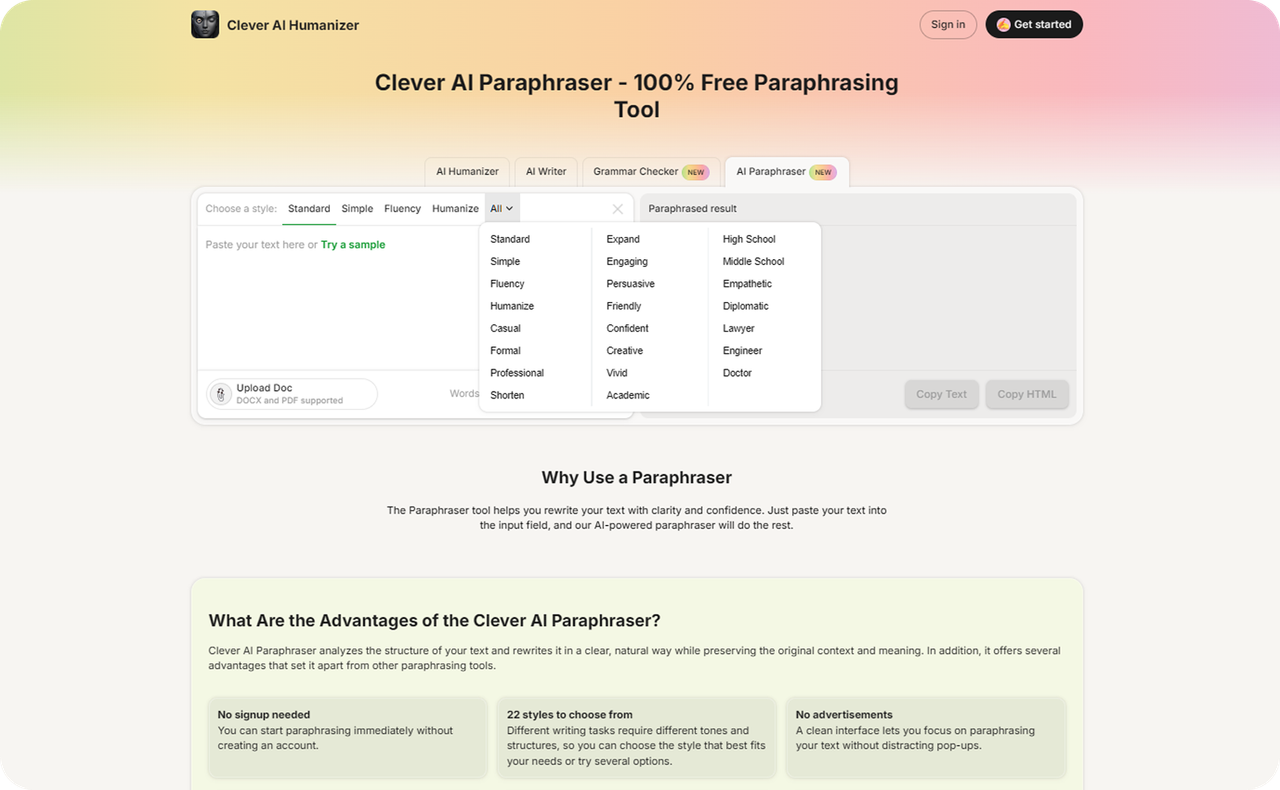
- Paste your text into the left input panel. The tool processes up to 1,000 words per pass – if your draft is longer, work section by section.
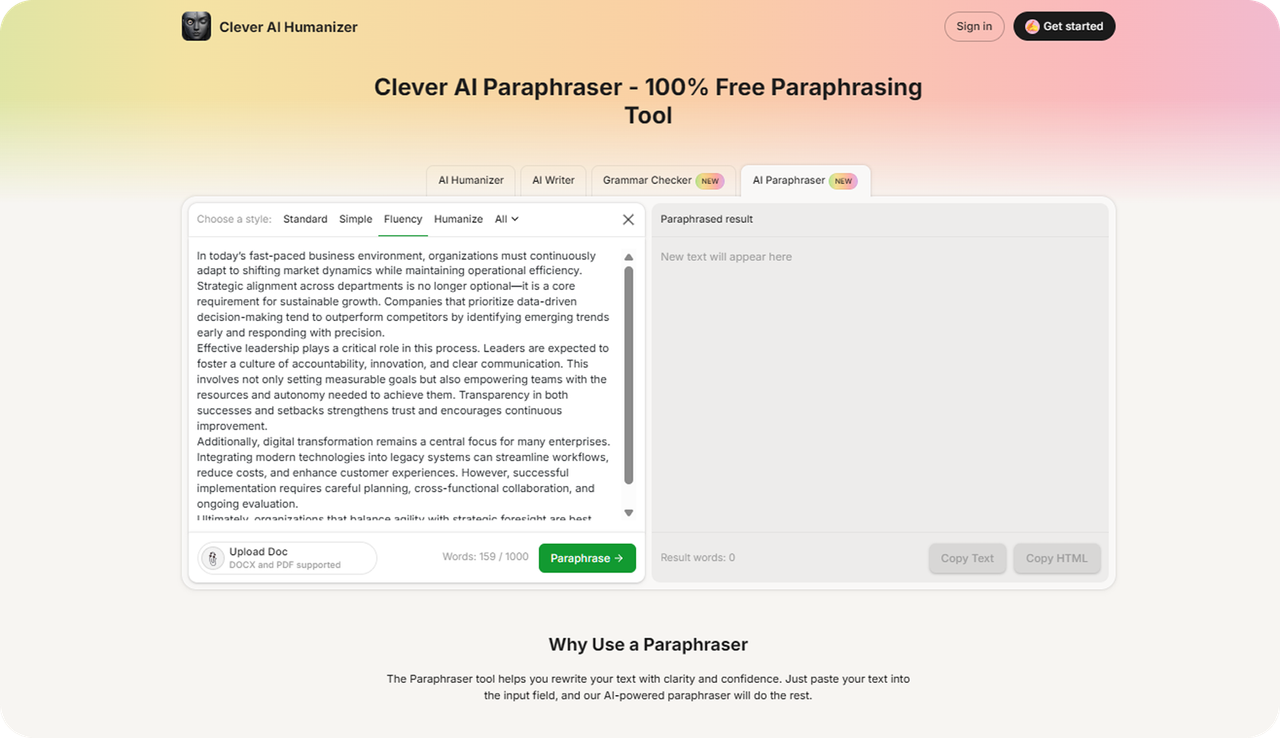
- Click the Paraphrase button. The tool rewrites each paragraph at the clause level – from the semantic meaning of your text, not its surface words.
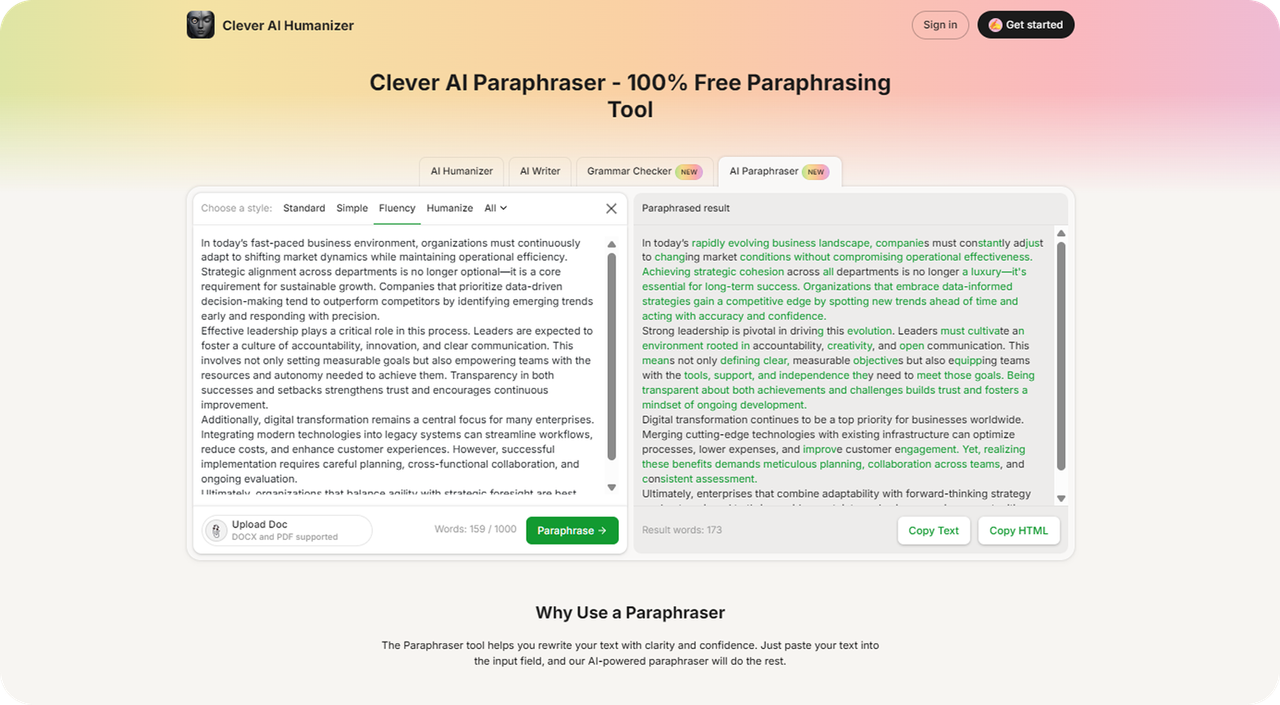
- When the output appears in the right panel, read through every change highlighted in green. Confirm that the clause entry differs from the source draft and that no technical term was altered.
- If any paragraph still mirrors the source frame, copy it back into the left panel, adjust the clause opening manually, and run the paraphrase pass again on that section.
- Click the Copy Text button below the right panel to transfer the result to your document.
- Open the Free AI Grammar Checker as a separate tool. Do not run it immediately after the paraphrase pass in the same tab – open it in a fresh tab.
- Paste the copied text into the grammar checker input panel and click Check my grammar.
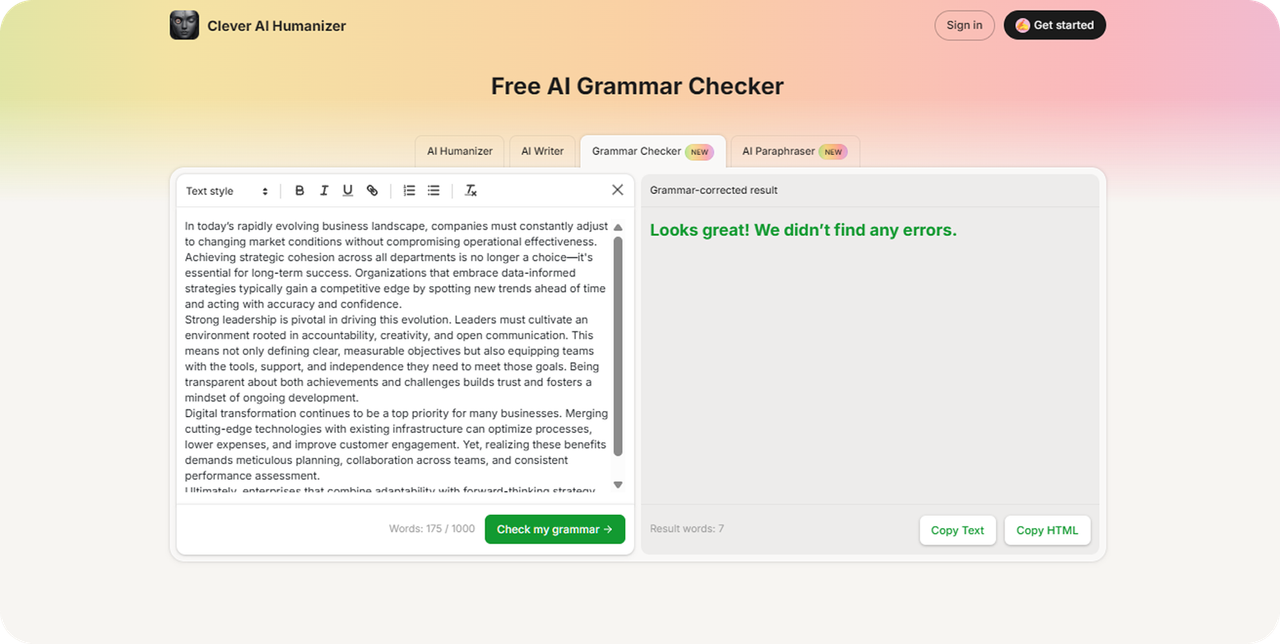
- Review each flagged item individually and accept or reject the suggestion. Agreement errors and tense shifts introduced at paragraph joins are the most common flags at this stage.
We ran this two-pass sequence on three academic texts within a 21-sample test across two checkers. For Clever AI Humanizer specifically, detection averaged 4.45% on both Turnitin and Copyscape, and grammar quality held between 8.0 and 9.0 out of 10 across those three runs. Clear both checks before any essay or science paper goes to a grader.
Four Patterns That Trigger Plagiarism Flags in College and School Papers
Even with the source engagement sequence in place, the patterns below are what trip automated detectors and draw a professor's attention during manual review. Each appears across essay types from school-level reports to university science papers. The table maps what each looks like in practice, why it produces a flag, and the fix that removes it.
|
Pattern |
What it looks like |
Why it flags |
The fix |
|---|---|---|---|
|
Mosaic Construction |
Correctly paraphrased sentences assembled in the same sequence as the source – claim, then evidence, then conclusion, in source order. |
Turnitin's algorithm detects argument sequence at the paragraph level, not just the sentence level. Professors recognise the logic flow even when no single sentence matches. |
Present evidence before the claim, or group two sub-points differently from the source order. At least two body paragraphs must follow a different sequence from the original. |
|
Patchwriting |
The source sentence frame was kept intact, with selected words replaced by synonyms. The result sits between a direct quote and original prose. |
Plagiarism checkers extract three-to five-word phrase junctions. When the clause frame stays, those junctions remain recognisable regardless of vocabulary changes. |
Change the clause entry point. If the source opens with the subject, open your version with a result clause, a conditional, or a time marker. The junction pattern breaks when the opening structure differs. |
|
Citation Placement Error |
The citation appears after a transition sentence the writer added – rather than at the boundary of the paraphrased idea itself. |
The paraphrased block reads as unsourced. The checker flags it the same way as deliberate plagiarism, regardless of intent. |
Place the citation marker at the last word of the paraphrased idea, before the period, before any sentence you wrote independently. Not after. Not at the paragraph end. |
|
AI Sentence Rhythm |
Even sentence lengths, subject-first clause entries, and low-variation connectors – the structural fingerprint of unmodified AI-generated text surviving a surface-level paraphrase. |
Turnitin runs an AI writing check alongside its similarity check and reports both scores. A paper can clear the similarity threshold and still flag the AI check because the structural rhythm was not addressed. |
Vary sentence length within each paragraph (one sentence under 12 words, one over 25). Change the clause entry on at least two sentences per paragraph. A clause-level rewrite removes the rhythm; a synonym pass does not. |
The four patterns share one root cause: the writer stayed too close to the source during the rewrite – either looking at it while editing, or working sentence by sentence rather than by argument block. The source engagement sequence above removes that proximity before a single draft sentence exists. When the sequence is followed, and those patterns still appear, the fix in each table row is the targeted correction. The Guardian has reported on how UK universities apply both automated detection and academic judgment to the same submissions, which is exactly why fixing the pattern in the detector does not remove the need to fix it for the human reader. What a corrected paraphrase looks like at submission is what the next section describes.
What a Submission-Ready Academic Paraphrase Looks Like
A paraphrase that clears academic submission requirements has three observable characteristics – one for each obligation the checker evaluates.
At the sentence level, no three-word phrase cluster from your text matches the source directly. Each paragraph opens with a clause type that differs from the source – if the source opens the paragraph with a claim statement, your version opens with evidence, a condition, or a result. Sentence lengths vary within each paragraph: at least one sentence runs under 12 words, and one runs over 25. Uniform sentence rhythm is one of the most reliable signals of non-original composition that both AI detectors and trained professors identify, whether the source text was AI-generated or human-written.
At the argument level, the sequence of claim and evidence in your essay differs from the source in at least two body paragraphs. A professor familiar with the source paper cannot predict which sentence comes next in your version. The conclusion of your paraphrase reaches the same position as the source's conclusion but arrives through a different path of sub-claims and supporting evidence.
At the attribution level, every paraphrased block in the academic paper carries an in-text citation at the boundary between the source's idea and your own transition language – placed before the period, before any sentence you wrote independently. No block from a source appears in the essay without attribution, and no citation appears after a sentence that belongs to your own analysis.
FAQ
Does a similarity score below 15% mean the paper is safe to submit?
Not automatically. A score below 15% clears the automated similarity check, but Turnitin also reports a separate AI writing score at the same time – and a paper can pass the similarity threshold while still flagging the AI check if sentence rhythm from the original was not addressed at the clause level.
How does academic paraphrasing differ from paraphrasing for general content?
Academic paraphrasing requires an in-text citation at every paraphrased block, formatted in a specified style – APA, MLA, or Chicago, depending on the discipline – placed at the boundary of the paraphrased idea, not after a transition sentence. Academic writing is also checked against institutional databases that general web checkers do not access, which makes the phrase-cluster threshold stricter in practice than a web-check percentage suggests.
Can technical terms in a science paper be paraphrased?
No – any attempt to do so distorts meaning. Plagiarism checkers flag clause architecture and phrase junctions in framing sentences, not subject-matter vocabulary, so the correct approach is to hold technical terms verbatim and restructure the connecting language around them.
What causes a high similarity score after a full structural rewrite?
The most common cause is mosaic construction – the argument sequence still mirrors the source at the paragraph level, even when individual sentences differ. Citation placement errors are the second cause: a citation placed after a transition sentence rather than at the boundary of the paraphrased idea makes the paraphrase block read as unsourced to the checker.
Final Words
Plagiarism in academic writing is almost always a process failure, not an intent failure. The writer read the source with the draft open, or paraphrased sentence by sentence without a structural plan, or placed a citation one sentence too late. None of those errors requires dishonesty to produce a flag – they only require staying too close to the source for too long. That is the problem this guide addresses at every stage.
The sequence matters as much as the individual steps. A structurally correct paraphrase without a citation still fails. A correctly cited passage that retained the source's clause frame still flags. A clean Turnitin score on a paper that carries an AI sentence rhythm still triggers the AI check. Each layer has to clear independently, which is why the guide separates them: source engagement before the draft, structural rewrite before the grammar pass, and similarity check before submission.
One thing academic writers often overlook: the notes file you build in Phases 1 and 2 is not just a drafting tool. It is documentation. If a professor or department questions a submission, a notes file that predates the draft – showing claim-level annotations written before the draft existed – is the clearest evidence that the work is original. Keep it until the course ends.
Clever AI Humanizer handles the clause-level rewrite that these steps lead to. Run the paraphrase pass first, then the grammar checker as a separate pass afterward, and check both the similarity score and the AI score before you submit. The tool is free for up to 200,000 words per month.